
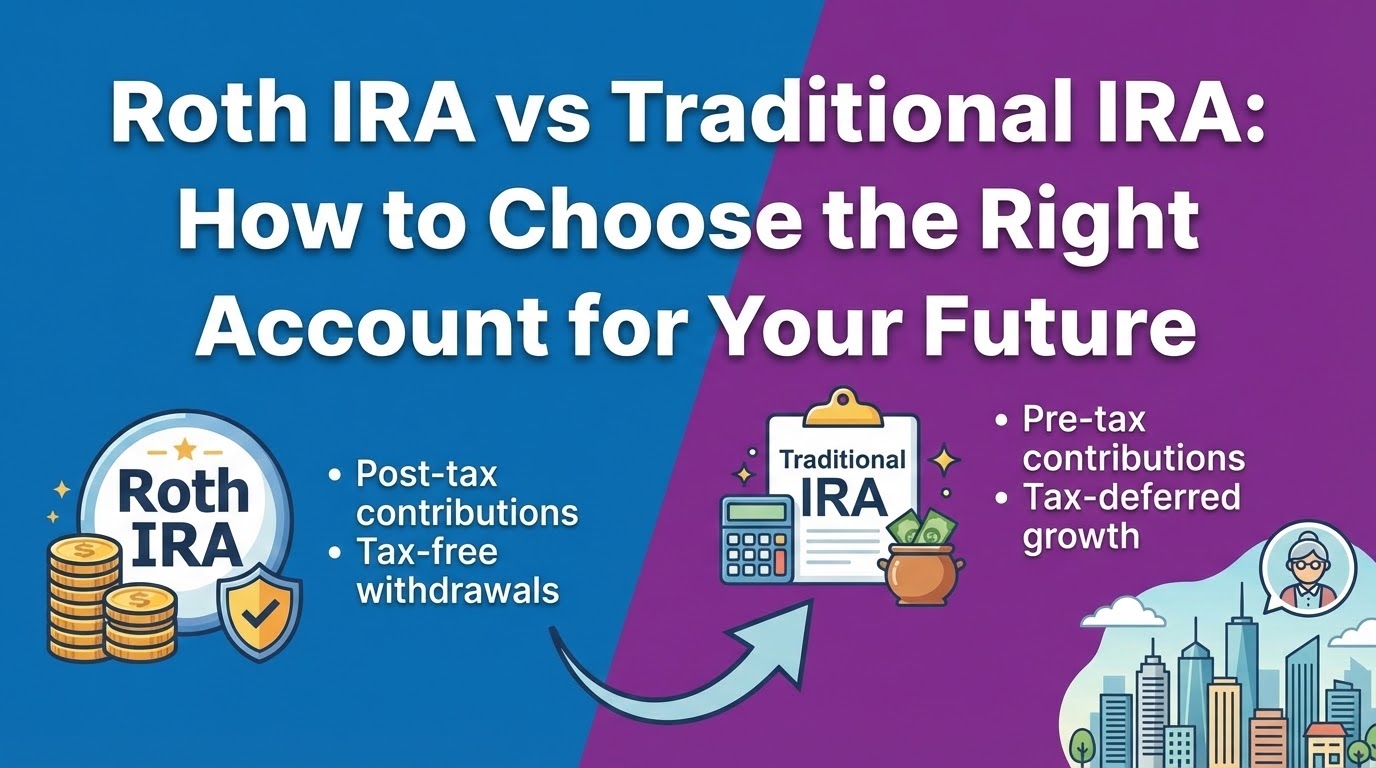
If you’ve searched Roth IRA vs Traditional IRA, you’ve probably seen the same recycled advice: “It depends on your tax bracket now versus later.” That’s true, but it’s not enough to make a confident decision. Most people aren’t choosing between two abstract tax structures. They’re choosing between two different financial futures. One path gives you a tax break now and taxable income later. The other asks for discipline today in exchange for tax-free flexibility tomorrow.
In 2026, that choice matters more than ever. Families are balancing higher living costs, uncertain future tax policy, and longer retirement timelines. Young professionals are asking whether they should lock in future tax-free growth. Mid-career earners want to know if they should grab deductions while their income is high. Business owners and side hustlers are trying to stack tax efficiency with long-term wealth building.
This guide gives you a practical framework. You’ll get a plain-English breakdown, common mistakes to avoid, and a clear decision process you can use today.
What Roth and Traditional IRAs Actually Do
At the highest level, both accounts are designed to help you invest for retirement with tax advantages. But the tax timing is opposite.
Roth IRA: Pay Taxes Now, Withdraw Tax-Free Later
With a Roth IRA, you contribute money that has already been taxed. You don’t get a tax deduction this year. In return, qualified withdrawals in retirement are tax-free, including growth. That means if your account compounds significantly over 20 to 30 years, every dollar of that growth can potentially come out tax-free.
Traditional IRA: Deduction Now, Taxes Later
With a Traditional IRA, contributions may be deductible today, depending on your income and whether you have a workplace retirement plan. Investments grow tax-deferred, but withdrawals in retirement are taxed as ordinary income. For many households, this means immediate tax relief now, with a larger future tax bill later.
Why This Difference Is Bigger Than It Looks
The difference is not just about this year’s tax return. It affects:
- Your future retirement cash flow
- How much control do you have over taxable income in retirement
- Eligibility for other strategies is tied to adjusted gross income
- How confidently can you plan withdrawals during market downturns
The Basics You Should Know Before Deciding. You do not need to memorize the tax code, but you do need to understand a few key rules.
Contribution Limits
IRA contribution limits are set by the IRS and can be adjusted over time. Always verify current-year limits before funding your account. If you’re age 50+, catch-up contributions may apply.
Income Limits for Roth Contributions
Roth IRAs have income phaseouts. If your modified adjusted gross income is above the threshold, your direct Roth contribution may be reduced or disallowed.
Traditional IRA Deduction Rules
A Traditional IRA contribution is not automatically deductible. Deductibility depends on income and whether you or your spouse is covered by a workplace retirement plan.
Withdrawal Rules
Roth IRA: contributions can generally be withdrawn at any time without tax or penalty; earnings are subject to separate rules.
Traditional IRA: withdrawals are taxable, and early withdrawals are subject to taxes and penalties unless an exception applies.
A good decision requires matching these rules to your current life stage and expected future trajectory.
The Real Decision Framework: 7 Questions That Settle It
Forget generic advice. Use these seven questions to choose the better fit.
1) Do You Expect Your Tax Rate to Be Higher, Lower, or Similar in Retirement? This is the core question.
- If you expect a higher future tax rate, Roth usually has the edge.
- If you expect a lower future tax rate, a Traditional IRA may be better.
- If you’re unsure, split contributions for diversification.
Many younger workers underestimate future tax exposure. Career growth, business income, and policy changes can push retirement income taxes higher than expected.
2) Do You Need a Tax Deduction This Year? If a deduction meaningfully lowers your stress today, Traditional IRA contributions can provide breathing room.
That said, don’t chase deductions at the expense of flexibility. A slightly lower tax bill now is not always worth a larger taxable bucket later.
3) Are You Early in Your Career? Early-career professionals often have lower incomes now than they’ll have in 10-15 years. Paying taxes at today’s lower rates through a Roth can be a smart long-term move.
4) Do You Value Flexibility and Tax-Free Withdrawal Planning? Roth accounts offer strong retirement planning flexibility because qualified withdrawals do not increase taxable income. That can help with:
- Medicare premium management
- Social Security taxation thresholds
- strategic withdrawals during market volatility
5) Are You a Side Hustler or Business Owner With Volatile Income? If your income swings year to year, you may benefit from a blended strategy:
- Higher-income years: prioritize deductible Traditional contributions
- lower-income years: prioritize Roth contributions
This approach aligns contributions with tax realities rather than forcing users into a single account forever.
6) Are You Behind on Retirement Savings?
If you are catching up, the best account is often the one you will actually fund consistently. Don’t let account perfection delay the momentum of contributions.
7) Do You Want Tax Diversification?
Many sophisticated savers build both taxable and tax-free retirement buckets. A mix of Roth and Traditional assets can give you more options later.
Practical Scenarios: Which Account Wins?
Scenario A: 28-Year-Old Professional, Rising Income
- Current income: moderate
- Expected income trajectory: strong upward growth
- Priority: long-term compounding
Likely winner: Roth IRA. Paying taxes at a lower current rate can be attractive when decades of growth are ahead.
Scenario B: 44-Year-Old Household in Peak Earning Years
- Current income: high
- Priority: tax relief this year + accelerated retirement saving
Likely winner: Traditional IRA if deductible. Current-year savings can be redirected into additional investments.
Scenario C: 36-Year-Old With Variable Self-Employment Income
- Income fluctuates year to year
- Needs flexibility
Likely winner: Hybrid strategy. Use Traditional in high-income years, Roth in lower-income years.
Retirement growth matters, but so does protecting your plan from disruption. If one disability or job loss can force you to stop contributions for years, your wealth strategy is fragile.
Common Roth vs Traditional Mistakes
- Mistake 1: Choosing Based Only on a Friend’s Advice: Your coworker’s best account may be wrong for your income, career path, and household structure.
- Mistake 2: Ignoring Income Limits and Deduction Rules: Many people assume they qualify for strategies they actually do not. Confirm eligibility before making contributions.
- Mistake 3: Waiting Until Year-End to Decide: Contributing late compresses your timeline and increases decision stress. Monthly automation wins.
- Mistake 4: Treating Retirement as Separate From Protection: A retirement plan without income protection is vulnerable. If your paycheck disappears, your IRA contributions usually disappear too.
- Mistake 5: Doing Nothing Because It Feels Complex: Analysis paralysis costs real money. A simple, consistent contribution to the right-enough account beats a perfect plan that never starts.
A 30-Minute Action Plan You Can Use This Week
If you want progress without overcomplication, follow this sequence.
- Step 1: Estimate Your Current Marginal Tax Bracket
- Use your latest pay stub or tax return to get a rough estimate of your bracket. Precision is useful; perfection is not required.
- Step 2: Make a Reasonable Future Tax Assumption
- Ask: Do I expect to earn more, less, or similar over my career? Keep it realistic.
- Step 3: Check Roth Eligibility and Traditional Deductibility
- Verify your contribution path before transferring money.
- Step 4: Pick One Default
- mostly higher future tax expectation: Roth default
- mostly lower future tax expectation: Traditional default
- uncertain: split contributions
- Step 5: Automate Monthly Contributions
- Set an auto-transfer tied to payday. Consistency is the engine.
- Step 6: Review Once Per Year
Re-evaluate after raises, business changes, marriage, or major life events.
How This Connects to the Bigger Financial Picture
IRA selection is important, but it should be part of a comprehensive plan. A resilient financial strategy usually follows this order:
- Stabilize cash flow and pay high-interest debt
- Build emergency reserves
- protect income and family obligations
- Invest consistently in tax-advantaged accounts
- Increase contributions as income grows
This sequence keeps your plan from collapsing under the normal pressures of life. It also aligns with a practical mission: protect families first, then build wealth with intention.
Final Recommendation: Choose a Direction, Not a Perfect Prediction
The right answer in the Roth IRA vs. Traditional IRA debate is rarely about finding a universal winner. It is about choosing the account that fits your current tax reality, expected trajectory, and behavior. If you are early in your career and likely to earn more over time, a Roth often makes sense. But are in peak earning years and qualify for deductions, a Traditional can be powerful. If you are uncertain, split contributions and revisit annually.
The biggest mistake is not choosing the wrong thing. The biggest mistake is delaying contribution momentum while trying to predict the future perfectly.
Conclusion
Families and professionals need retirement plans that are simple enough to maintain and strong enough to survive real life. The Roth-versus-Traditional decision is one lever, not the whole machine. Use it wisely, automate contributions, and keep building. DM INVEST for a personalized retirement account decision worksheet and contribution strategy map based on your income stage.
Leave a Reply